Coco’s Design Archive
MenuClose
CASE 05 · ECOLOGICAL DATA EXPERIENCE · SPRING 2026

Wild Signal

Making bird migration perceptible across place, season, and time.

A speculative glasses-mediated interaction and data-visualization experience that helps casual bird seekers understand where a species may be, why it is moving, and when observation may be possible.

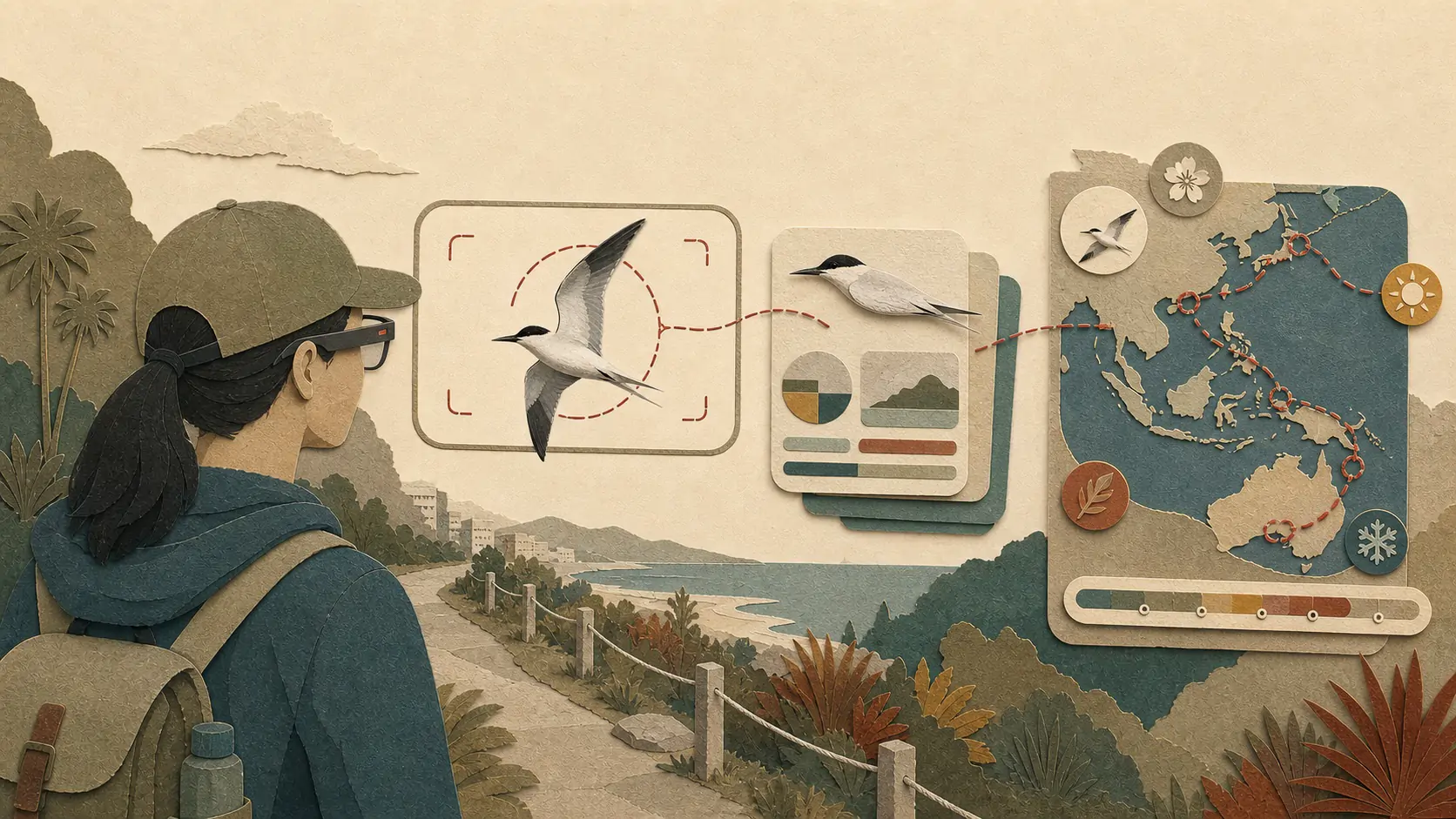
Wild Signal field story showing a bird seeker putting on speculative glasses, identifying a bird, and opening its migration route
GLASSES-MEDIATED FIELD STORYOriginal project narrative asset · exact interface and research evidence continue below
FIELD → CONTEXT → TIMEA seasonal migration storyIllustrative cover · exact UI below
MY CONTRIBUTIONResearch synthesis · field-to-dashboard flow · seasonal data model · interaction design · final experience narrative
ROLEProduct Designer
CONTEXTCollaborative academic concept · Spring 2026 · speculative glasses-mediated interaction
SCOPEField interaction + dashboard connecting a sighting to species, season, migration route, and observation timing
01
CONTEXT + INTENT

Start with the gap between ecological data and everyday understanding.

Migration data exists, but a casual nature lover still has to translate datasets into a place, a moment, and a decision.

01MIGRATION RANGEAudubon

Annual movement and species-range context

02SEASONAL ACTIVITYBirdCast

Regional migration signals across time

03OBSERVATION CONTEXTCornell Bird Cams

A human-scale window into bird behavior

INTERPRETATION GAPCredible data still needs a place, a time window, and visible uncertainty.
AVAILABLE

Routes, seasonal activity, live observations.

Credible public sources can show migration patterns and sightings at multiple scales.

MISSING

A legible answer to “what does this mean here?”

The research reframed the opportunity from displaying information to translating relationships.

HOW MIGHT WE

Help a casual bird seeker understand where a species may be—and why—without asking them to become a data expert?

01 · EVIDENCEAudubon · BirdCast · Cornell

Routes, seasonality, and live observations

02 · GAPData needs translation

A place and moment are still hard to interpret

03 · INSIGHTContext before detail

Where + when + visible uncertainty

04 · DECISIONLens → timeline

Progressive disclosure preserves continuity

05 · PROOFComprehension test

Route recall, cause, confidence, handoff

02
RESEARCH SYNTHESIS

One journey, six shifts in understanding.

ILLUSTRATIVE SYNTHESIS · NOT MEASURED DATABird seeker tracking a seasonal signal

Follow the qualitative comprehension pattern, then open any phase to see the design opportunity.

AWARENESS
USER GOAL

Find a promising place to observe birds.

FRICTION

Migration is invisible and timing feels unpredictable.

DESIGN OPPORTUNITY

Surface a seasonal signal before the user has to interpret a map.

Migration data becomes useful only when it is translated into a place, a time window, and visible uncertainty.
02B · USER EXPERIENCE · SOURCE-DECK SCENARIO

Meet Kathrine Lee.

A casual observer who wants to understand what she sees without becoming a bird expert.

Kathrine Lee scenario persona from the source Wild Signal Figma Deck
SCENARIO PERSONA · NOT A RESEARCH PARTICIPANT
27Marketing CoordinatorPasadenaMedium tech confidence
“Help me know what the bird is, where it is going, and when I might see it again.”
DESIGN OPPORTUNITYTurn a brief outdoor sighting into a clear, time-based observation decision.
ACT 01 · FIELD EXPERIENCE · SOURCE-DECK SCENARIO

From curiosity to a named observation.

Scroll through Kathrine’s intended journey. Each scene is source-deck scenario imagery—not a research photograph or measured usability result.

Source-deck scenario image of Kathrine preparing to leave with smart glassesFIGMA DECK · SCENARIO VISUAL · NOT A PARTICIPANT PHOTO
01 · PREPARE
Set a field intention.

Kathrine leaves home with lightweight glasses, ready to notice rather than search a dashboard.

USER QUESTION
What should I bring into the field?
UI RESPONSE
The experience begins with a deliberate, low-attention wearable cue.
DESIGN DECISION
Keep setup minimal so curiosity—not configuration—starts the journey.
Open the source-deck journey recap
Source-deck recap of Kathrine seeing a bird, receiving lightweight AR information, and exploring deeper data at home
FIGMA DECK · SOURCE SCENARIO RECAP · PROGRESSIVE DISCLOSURE
ACT 02 · EXACT FIGMA UI · THREE SYSTEM STATES

One encounter becomes a readable migration story.

The field moment now expands into the exact source UI: Pasadena current state, migration in progress, and Miami arrival.

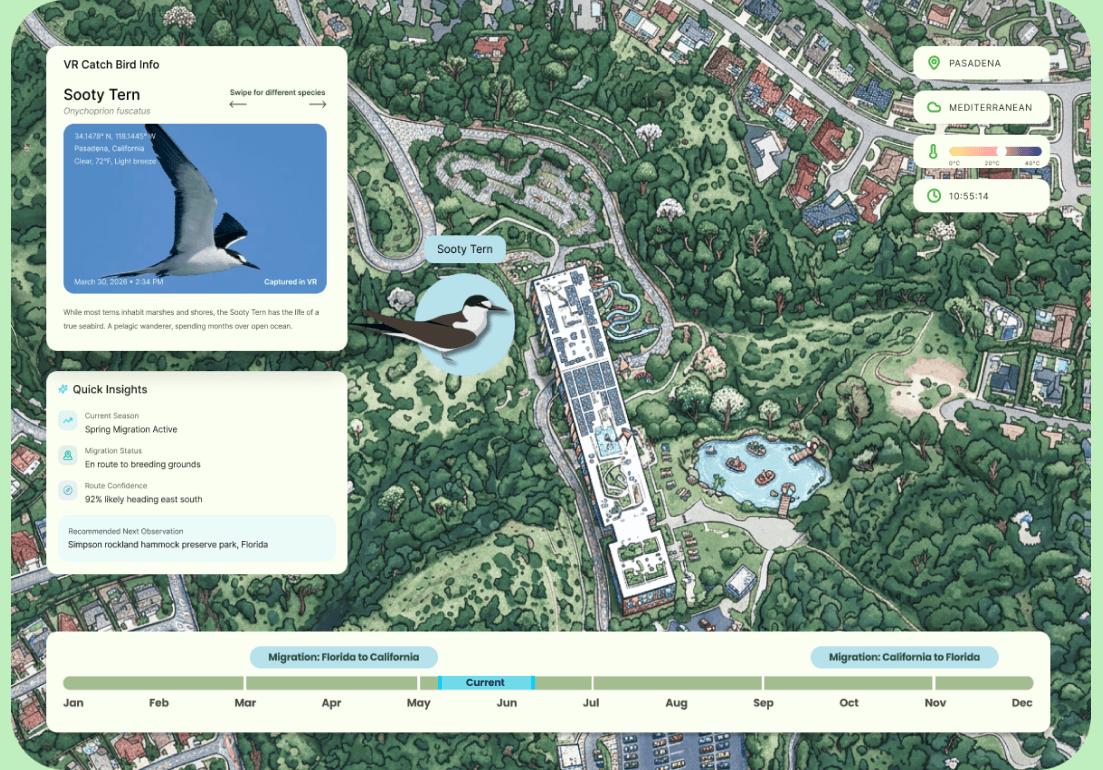
Sooty Tern interface showing the current Pasadena state and annual migration timelineEXACT FIGMA UI · SLIDES 16 · NO GENERATED REPLACEMENT

EVIDENCE BOUNDARY Kathrine Lee is a scenario persona in the source deck. This walkthrough communicates an intended experience, not a measured usability outcome.

03
EXPERIENCE ARCHITECTURE

From a field signal to a time-based decision.

The experience deliberately changes information density as the user moves from noticing to planning.

01

Outdoor sighting

A bird or sound creates a short, place-specific moment of curiosity.

02

Put on glasses

The user deliberately enters the speculative lens experience.

03

Detect bird

A restrained field cue locates the bird without covering the view.

04

Identify species

Sooty Tern, confidence, and source context appear together.

05

Open map

The encounter persists as the experience expands to the larger screen.

06

Read migration route

Season, direction, distance, stopovers, and uncertainty become legible.

07

Plan observation

The user chooses a likely viewing window and saves the encounter.

FIELDBird / soundLens cueSpecies context
SCREENRouteSeason timelineViewing window
DATALocationTemperatureMigration stage
03B
UI DESIGN + ITERATION

Make each design decision visible—not just the final screen.

Exact source UI and revision artifacts reveal how the product moved from an exploratory map to a multi-species, time-based system.

Wild Signal final multi-species Pasadena map interfaceFIGMA DECK · SLIDE 24 · EXACT SOURCE UI
04 · FINAL DIRECTION

Connect field, time, and system.

The final map supports multiple species and layers identity, status, route, environment, and an annual timeline only when each question needs them.

DECISION

Preserve the captured bird, use time as a primary interaction, and reveal detail on demand.

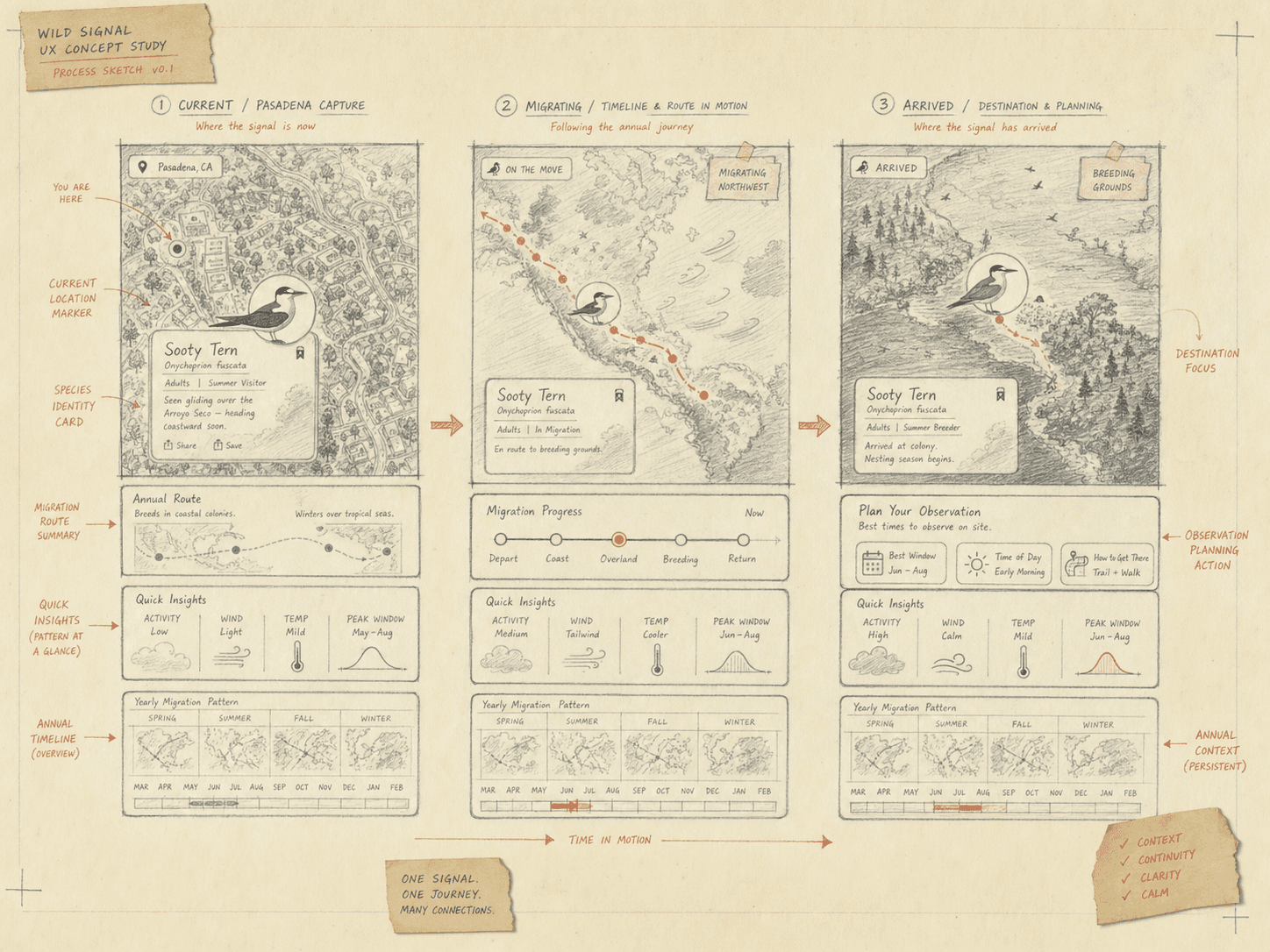
Pencil low-fidelity reconstruction of Current, Migrating, and Arrived Wild Signal interface states
ILLUSTRATIVE LOW-FI RECONSTRUCTION · BASED ON SOURCE UI · NOT FINAL PRODUCT UI
LOW-FI STATE MODEL

Current → Migrating → Arrived

The same species card, map, and timeline persist while status, route, and environmental context change.

  1. CurrentIdentity + present location
  2. MigratingRoute + time in motion
  3. ArrivedDestination + environmental context
INTERFACE AUDIT · RECONSTRUCTED FROM SOURCE SCREENS

A system for field, time, and confidence.

These roles are documented from the source interfaces; they are not presented as an original Figma component library.

Field canvasPlace + movement
Species identityName + status
Annual timelineSeason + direction
Insight surfaceDetail on demand
  1. Capture cue
  2. Species card
  3. Status chip
  4. Location marker
  5. Route summary
  6. Quick insights
  7. Timeline
  8. Planning action

MOTION LOGICNotice → Identify → Expand → Scrub time → Understand route → Plan observation

04
PRODUCT EVIDENCE

One captured bird becomes a readable migration story.

Scroll through exact Figma interfaces as field capture becomes a time-aware migration system.

PRODUCT EVIDENCE · EXACT FIGMA UI

One captured bird becomes a readable migration story.

Scroll to follow the same interface from field capture to the final system view.

AUTHENTIC PRODUCT SCREENFigma Deck · slide 16
OPEN SUPPORTING ARTIFACTExperience flow from the same Deck+
PRODUCT EVIDENCE · EXACT FIGMA UI

From field capture to a migration system.

Each card preserves the interface exactly as it appears in the Deck.

01FIELD → SYSTEM

Capture a bird. Keep the context.

The lens identifies the Sooty Tern in Pasadena, then preserves place, weather, time, and confidence when the experience expands to the dashboard.

DESIGN DECISIONContext before prediction
Figma Deck · slide 16 · exact source artifact
02TIME IN MOTION

Make migration legible while it happens.

The route view changes the information hierarchy: distance, duration, current position, and destination become the primary reading order.

DESIGN DECISIONMovement becomes a timeline
Figma Deck · slide 17 · exact source artifact
03STATE CHANGE

Arrival closes one loop and opens the next.

When the bird reaches Florida, the interface updates the location state instead of presenting migration as a static line on a map.

DESIGN DECISIONThe system explains what changed
Figma Deck · slide 18 · exact source artifact
04FINAL DIRECTION

Unify field cues and annual patterns.

The selected final dashboard keeps the captured bird, quick insights, environmental context, and the annual migration timeline in one continuous view.

DESIGN DECISIONPerception connects to a system
Figma Deck · slide 24 · exact source artifact
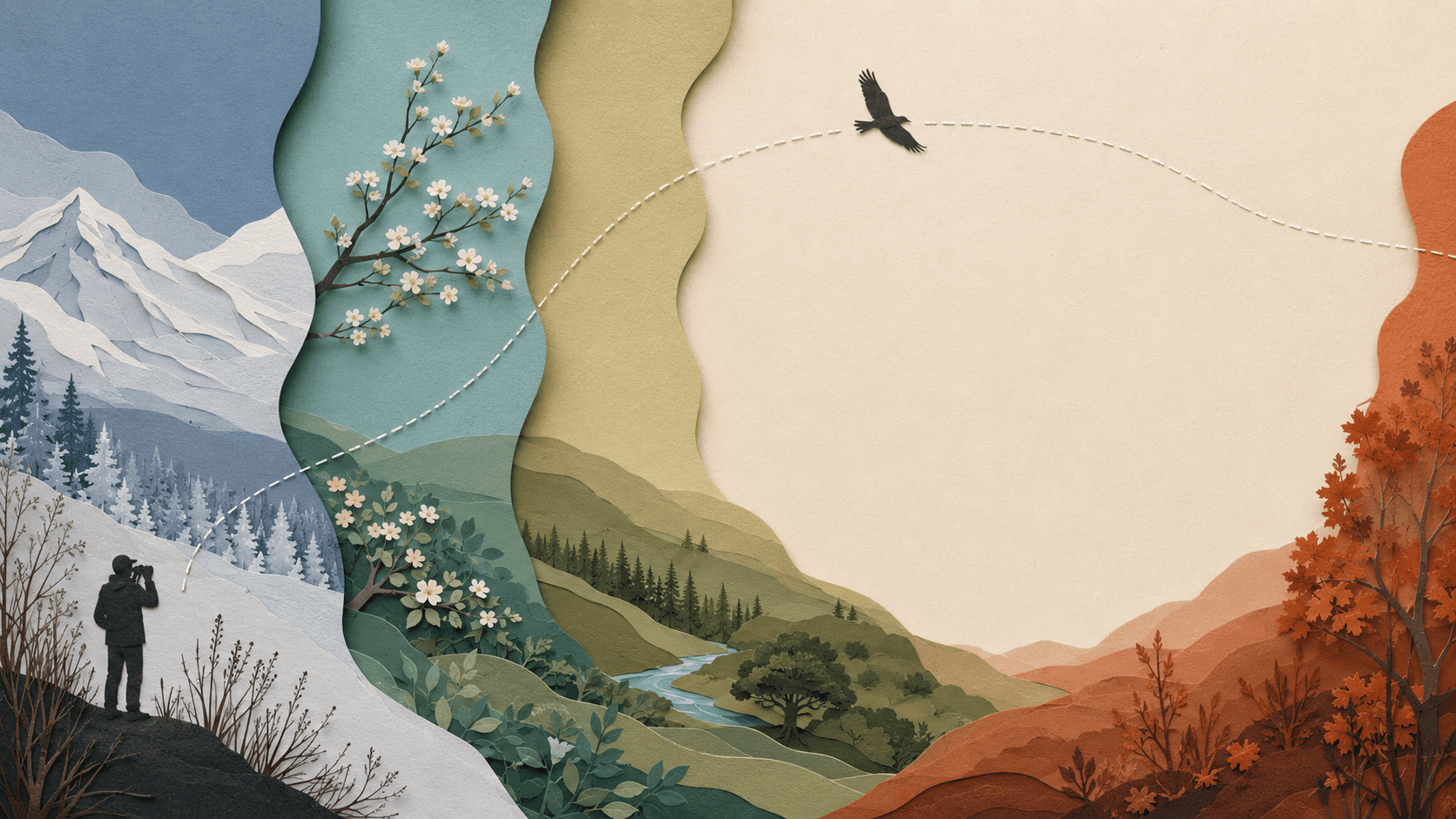
Cut-paper landscape tracing a bird migration across four seasonsFOUR-SEASON MIGRATION STORY · STATIC MOBILE EDITION
Figma Deck · slide 24 · exact source artifact
01Context before detail

Show what is here, now, before exposing the full annual route.

02Motion carries meaning

Route animation communicates direction and stage; it is not decorative movement.

03Uncertainty stays visible

A confidence state prevents the lens from pretending to know more than the evidence supports.

04Physical → digital continuity

Species and location persist when the user expands from lens to dashboard.

05
VISUAL + SEASON SYSTEM

One ecological language across four climates.

01 · PLACEStart from what the observer can recognize.

A field cue anchors the story before the interface expands.

02 · TIMELet season change the meaning of the same route.

State, direction, and observation window move together.

03 · UNCERTAINTYKeep the boundary of the evidence visible.

The concept explains a relationship; it does not claim live prediction.

DATA HIERARCHY

Where observation + range

When season + stage

Why context + change

How sure confidence + source

06
FINAL FORM

A speculative glasses-mediated concept—presented honestly.

The source work demonstrates a post-produced, glasses-mediated interaction story. It does not claim deployed smart-glass hardware or live recognition.

Original glasses-mediated field interaction narrative asset
  1. 01Notice in place

    A bird or sound starts the question.

  2. 02Reveal context

    Season, route, and confidence explain the signal.

  3. 03Expand through time

    The dashboard supports planning and reflection.

CONCEPT BOUNDARY

Speculative glasses-mediated interaction, not deployed hardware.

The value of the concept is the interaction story: recognition in the field, contextual explanation, and a time-based dashboard. The hardware remains a future implementation question.

Demonstrated
Story, UI states, season system, interaction narrative
Not demonstrated
Live recognition, production data, working smart-glass hardware
Next proof
Comprehension test + Wizard-of-Oz field prototype
06B
PROJECT FILM / FIELD TEST

Scroll from a missed sighting to a migration decision.

The supplied 56-second project film is scrubbed silently as the story progresses; the complete version remains available with its recorded audio. If Framer has not uploaded the local default yet, select it in the Film control.

01 · FIELD MOMENT

Outdoor sighting

A bird or sound starts the question before the moment disappears.

SCROLL TO SCRUB THE FIELD STORY ↓

Scroll can scrub the muted film, or use the video and chapter controls independently.

Read the field-film text alternative
  1. 01 · FIELD MOMENTOutdoor sighting

    A bird or sound starts the question before the moment disappears.

  2. 02 · ENTER LENSPut on glasses

    The user deliberately enters the speculative glasses-mediated experience.

  3. 03 · DETECTION CUEDetect bird

    A restrained marker locates the bird without covering the outdoor view.

  4. 04 · SPECIES CONTEXTIdentify species

    Sooty Tern, confidence, and source context make the detection legible.

  5. 05 · FIELD TO SCREENOpen map

    The encounter persists as the experience expands to the map.

  6. 06 · MIGRATION INTELLIGENCERead migration route

    Season, direction, distance, stopovers, and uncertainty explain movement.

  7. 07 · DECISIONPlan observation

    The user chooses a likely viewing window and saves the encounter.

07
VALIDATION + VALUE

Define what the next prototype must prove.

No outcome metric is fabricated. These measures are a validation plan for the next round.

QUESTIONTASKSIGNAL
01Route comprehension

Can a casual nature lover explain where the bird is and where it goes next?

Path recall · stage comprehension
02Cause + context

Can the user connect season and temperature to movement without prompting?

Relationship recall · misconception count
03Field-to-screen handoff

Can the user move from the lens cue to the full dashboard without losing context?

Task completion · backtracking
04Decision confidence

Can the user choose a viewing window and explain the uncertainty?

Decision confidence · uncertainty recall
WHAT WORKED

Move from “show the map” to “explain the changing relationship.”

The strongest idea is the bridge between a small moment in place and a large migration pattern over time.

WHAT I WOULD CHANGE

Test comprehension before adding immersion.

A low-fidelity field prototype should establish whether the route, season, and confidence model is understandable before investing in hardware.

PORTFOLIO VALUE

Research → system → interaction → honest boundary.

The project demonstrates how I structure a speculative experience without presenting an unbuilt concept as a shipped product.